Showing posts with label Black Hole. Show all posts

Friday, 12 February 2016

So what are Gravity Waves


Two black holes, when they met, cause a cavity
In the space time contin’um called gravity
And the waves, fast as light,
Prove that Einstein was right,
As the scientists claim, with audacity.

The science involves much complicated mathematics but a simple model will explain the basic idea.

Wednesday, 8 October 2014

Wednesday Science Limerick - The Language Enigma

The Tower of Babel
We use our intelligent brain
To speak phrases – both bright and mundane
Are we really so clever
That despite all endeavour
Its real workings we’ll never explain.


When I started this blog I drew attention to the black hole in brain research and have referred to the subject on various occasions since. Now a paper How Could Language Have Evolved published at the end of August by Johan J. Bolhuis, Ian Tattersall, Noam Chomsky and Robert C. Berwick which demonstrates that, at least as far as the origins of language are concerned, they agree that there is a significant problem. Their abstract begins:

The evolution of the faculty of language largely remains an enigma. In this essay, we ask why. Language's evolutionary analysis is complicated because it has no equivalent in any nonhuman species. There is also no consensus regarding the essential nature of the language “phenotype.” 

My views on the subject suggest that they have been busy digging a very deep hole in the wrong place.  I am just getting things back together after a month's holiday entertaining a visitor from Australia but hope to have a post describing where they should have been digging by the end of the week.

Tuesday, 22 July 2014

The Trouble with Brain Science - History suggests possible solutions


Professor Gary Marcus, Professor of Psychology, At New York University has just written an interesting  article "The Trouble with Brain Science" in the New York Times. This relates to the to the open letter sent by hundreds of scientists who consider the latest EU funding proposals for brain research are unsatisfactory. Gary's article clearly states views about the current state of brain studies.
Neuroscience awaits a similar breakthrough. We know that there must be some lawful relation between assemblies of neurons and the elements of thought, but we are currently at a loss to describe those laws. We don’t know, for example, whether our memories for individual words inhere in individual neurons or in sets of neurons, or in what way sets of neurons might underwrite our memories for words, if in fact they do.
This is just one of the hundreds of articles that have appear in the media in the last few weeks - and relates back to my post several tears ago under the title Brain Storms - 2 - The Black Hole in Brain Research.

Perhaps the difficulty is that when a lot of scientists have been looking very hard for a solution to an important problem it is assumed that it is a very difficult problem and more and more scientists pile in to dig the hole deeper. This approach only works if everyone is digging in the right place ...

There are some interesting precedents if one looks back in history

The Ptolemaic system of epicycles attempted to explain the apparent movement of the planets in the night sky, and tried to  explain their movements in terms of a number of linked circular motions. As measurements became more accurate the number of these epicycles needed to increase and the problem of working out what was happening - although if powerful computers had existed at the time we might still be stuck in the scientific past with epicycles within epicycles within epicycle to the nth degree.  The only reason the Ptolemaic model lasted as long as it is is that we are not dispassionate independent observers - and as the big-headed animals that we are  we considered that we must be at the centre of everything. All that was needed was to step back a bit and put the Earth on which we live in a wider context.

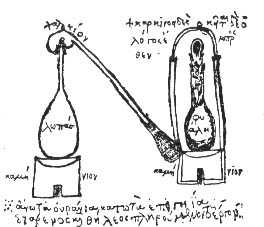
Ambix, cucurbit and retort
The Eighteenth Century chemists had a different problem in that they believed their eyes. At the time they were trying to isolate and identify the elements that were the building blocks of the world we live in. One of the most easily observed and spectacular elements was Phlogiston. There was no doubt that it was important and they needed to get a sample so that they could examine its properties in detail. It was very easy to make, a very large number of everyday materials contained it in profusion, and if you put animals in jars with air containing Phlogiston they died. Try as hard as they could they repeatedly failed to isolate it and put it in a bottle. However the experiments by Joseph Priestley produced a gas which was called dephlogisticated air because it didn't contain any Pholgiston. This gas caused substances which contained Phlogiston to release it very readily.

In fact the search for the element Phlogiston was fruitless – because what appeared to be Phlogiston being created was the light and energy when things burn in oxygen, and they were trying to capture heat and light as if it was a solid substance.

Perhaps the current difficulties in understanding in understanding how the brain holds and processes memories is that we have been asking the wrong questions. As regular followers of this blog will know I am currently drafting a paper describing a model which promises to bridge the gap.  Some aspects of the model have already been aired on this site, and more is in the pipeline, but the two historical examples point to two "outside the box" areas I am exploring.

Self importance

Judy Horacek(C)  www.cathtatecards.com
We are very special. Just look at all the things we can do that other animals living on this planet can't do. We are so successful that our activities are rapidly altering the climate, and we know how to build magnificent weapons of mass destruction. But of course, if we succeed in changing the world so much that we (and many other plants and animals) become extinct, we will just be another dead end branch of the evolutionary tree of life. We have already dismissed the Ptolemaic system and realised that we are not at the centre of the universe. What we need to do is to climb down from the pedestal we have created and  try and take an objective view.

In my model of the brain I start by assuming that our brains are really no better than those of at least the higher animals, except that we have more capacity than most, if not all, other mammals. I then look at how an animal with such a brain might evolve to have the information processing powers that we have - and find that the very simple protocol the neurons in an animal brain need to process enough information to survive is sufficient to support virtually everything we do. The main difference is due to improvements in the speed of learning which allows us to exchange and remember cultural knowledge more easily. Better cultural knowledge means better tools - and the most important tool, which improves generation by generation is language.

Uncertainty and form

The Phogiston story shows we can be looking for the wrong kind of information. Phlogiston turned out to be energy waves and not a solid substance. Perhaps the questions "Where are memories stored?" and "How are they formatted?" are not the best questions to ask if you want an answer. Having got a Ph.D. in theoretical chemistry I accept without question the ideas behind Heisenberg's Uncertainty Principle and have never lost a minute of sleep over wondering whether Schrodinger's Cat is alive or dead.  After all an electron is both a particle or a wave, and only "makes up its mind" when it knows what question I am asking about it.

My brain model takes the physicist's "Ideal Gas model" as a guide - and assumes the brain can be considered as a sea of identical neurons, with different and variable strength links connecting them. You see a "Rabbit" and the eye "in effect" drops a suitable pebble of activity into the sea, generating a suitable wave of activity to spread over the surface of the neuron sea. At the same time your stomach drops a pebble of "Hunger" into the sea. The two wave trains intersect, and collapse onto a single neuron which becomes active and initiates a new wave "Rabbit Pie". The various groups of ripples represent the human short term memory - and it it is inappropriate to ask where a particular memory resides in the brain when the sea is perfectly calm. For instance my memory of my mother only exists when I am thinking about my mother - when there is an appropriate set of ripples in my short term memory.

And what about the EU proposals

Now at the start of this post I mentioned the protest letter about the E.U. funding plans. What we know is that over the years billions of man-years of effort appear to have been invested it trying to do something which every new-born child does automatically. The E.U. (and the U.S. government) have decided that we need to invest even more following our noses in the directions we have been looking because if we spend enough money going in a single direction we will eventually find the answer.

The examples of epicycles and Phlogiston show that if you have the wrong model it is very easy to waste good research resources trying to go down blind alleys. My research is trying to escape from the establishment brain research boxes which assume that we are more intelligent than animals and that you can find memory in specific locations if you look hard enough. O.K. As a scientist I know my model could be wrong (although many establishment scientists behave as if they knew they were right) but my experience with my research suggests that the current scientific world is very bad in recognising that significant out-of-the-box ideas can originate in unexpected out-of-the-box places.

Whatever your views on the E.U. proposals remember that this generation of scientists is not guaranteed to be right all the time, any more than of the previous generations were. The fact the Richard Dawkins called one of his books on evolution "Climbing Mount Improbable" should be warning enough that if we find ourselves facing a major scientific brick wall we should be prepared to step to the side and look for an out-of-the-box way round rather than waste money trying to scale impossible heights.

Tuesday, 10 September 2013

From Neural Code to Religion - An Evolutionary Model of the Human Brain

A New Look at the Evolution of the Human Brain
A talk given to the Chiltern Humanists on 10th October, 2013

The following notes outline the arguments which underlie the talk. Most technical information on the model of the neural code used, and the related CODIL research, are available on this blog, and I am happy to answer any questions/comments about more technical aspects of the research.

Tuesday, 28 June 2011

Brain Storms - 2 - The Black Hole In Brain Research

The whole issue of how the brain works, and the origins of human intelligence, are matters of considerable interest, and most universities will have several very different departments which have staff researching some aspect of the area. In hospitals and medical research departments people study the effects of injuries and illnesses that effect the brain. Modern equipment can identify electrical signals and locate their sources. Computer Science Schools may have departments of Artificial Intelligence, while there is interest among psychologists, educationalists, linguists, biologists, evolutionists and many others. In each speciality there will be a mountain of publications, many of excellent scientific quality. It is quite clearly impossible for anyone to be fluent with the current research right across the board and there is so much narrow specialisation that researchers in one area may find it very difficult to understand some of the other specialities,.

So lets all stand back as far as we can and take an overall, and hopefully non-partisan, look.

While the amount of knowledge we have of the brain has increased enormously in recent years there is a problem. If we were working towards some kind of unified theory of the brain the aim would be to link all these different disciplines together in a central model. What we find in the middle is more like a large black hole with people from different disciplines kibbling round the edge. For example there is no clear route which links the neurons to language learning or the ability to play chess well. Particularly when making comparisons with animals, one is even uncertain what how the term “intelligence “ should be defined.

An analogy might help to identify the problem. An alien life form with a very different technology visits this planet and takes away a number of working personal computers, each actively running a different application. The aim to investigate the nature of the intelligence inside the boxes. They make enormous progress. They “kill” one or two and find the circuit board and the various components and study these in great detail. They design monitors which tell them which components are electrically active and examine each application in great detail. For instance they discover that the chess is a game – and they use their own technology to play the game and win.

Despite all this research they still do not understand the key to these boxes apparent intelligence. What they are missing is an understanding of the instruction set of the central processor and the way it interacts with the memory, and the way this allows information for each application to be mapped onto the memory.

I am suggesting the the “black hole” in brain research is equivalent to the one described in the analogy. We know that the brain's central processors must be neurons, working singly or in groups, and that memory must be held somewhere in the network of nerves. The brain somehow uses this arrangement to support a wide variety of tasks (often different in different people) as varied as supporting one or more spoken languages, playing chess, flying an aeroplane, earning a living or arguing with 100% conviction for (or against) the existence of a god.

The target of these Brain Storms is to explore the options for such a “brain central processor” and one option that will be examined will be to look at of an unconventional computer language called CODIL, which was designed to be human friendly and which can demonstrably support a wide range of applications. This suggests some features suggesting one possible model, but there may be others and you suggests are very welcome.

The next few Brain Storms posts will look at the evolution of Mankind and what it tells us about the evolution of man's self- named “intelligence” and the possible relation between human and animal “intelligence”. I will then describes a provisional target model for the Storm – and start looking at how far the CODIL model succeeds, and fails in other ways, to meet the target. Hopefully by this stage other people with have joined in with other ideas – so that together we can define a possible predictive model for more detailed examination.