Thursday, 12 June 2014

A Mind-blowing Evening with Robin Ince

I attended Robin's evening with the Chiltern Humanists  at Amersham and really enjoyed it. While he had come with a computer and a prepared set of picture the chat started with setting up the systems and moved onto current topics with a short break when the chair interrupted to say that Robin really needed needed no introduction ... He touched on so many different aspects of science, in a humorous manner that it is hard to pick out any particular point to mention here. In relation to the mis-reporting in the media of Richard Dawkin's views of the role of fantasy in teaching children he told a marvelous story about his own son's first experience whit the tooth fairy. The story my not be true, but it emphasized the importance of encouraging children to use their imagination and questioning what they are told. 


In fact his lighted-heated banter about the marvels of science continued for almost an hour, to everyone's delight for nearly an hour at which point he remembered he had brought some pictures. All in all he covered all aspects of life and death (in the latter case in a light-hearted but moving way) and clearly understood the importance of communication science - and the unsatisfactory way that the media actually deals with it.

An Important Date for Your Diary

The radio program The Infinite Monkey Cage, with Robin Ince and Brian Cox, is back on July 7th with a new series of six programmes (and all the old programmes are available on the BBC Web site.. As far as I am concerned they are unmissable - Follow what is happeneing on  @themoneycage.

Wednesday, 11 June 2014

A Chatbot spouts rubbish to the media about the Turing Test


Alan Turing has set a hard test
To find out which computer chats best
About speedboats or fiddles
Or solving hard riddles
And fooling a real human guest


At the end of last week the media were full of stories of how Eugene Goostman, a guinea pig-owning, 13-year-old boy living in Odessa, Ukraine, (actually a computer program) had passed the Turing Test. I suspected it was another case of academic hype relating to those magic words "Artificial Intelligence" fooling the press and waited a few days for the reaction. As I expected the criticisms soon appeared - such as Celeste Biever writing in the New Scientist, the report That Computer Actually Got an F on the Turing Test on Wired, and Mike Masnick, who tears the whole publicity stunt to ribbons. Among many well-directed comments he says.
The whole concept of the Turing Test itself is kind of a joke. While it's fun to think about, creating a chatbot that can fool humans is not really the same thing as creating artificial intelligence. Many in the AI world look on the Turing Test as a needless distraction.
The Turing Test - Picture from 1clicknews
It helps to understand that Eugene Goostman is one of hundreds of bastard progrm descendants of Eliza, and early chat-bot program which attempted to carry out a simple conversation with a human being via a simple teletype. The "rules" in writing a chatbot seems to be that you keep on adding ad hoc rules to try and conceal the fact that your program does not really understand the human, and that the program writer does not understand how the human brain actually works. If all else fails the program takes approach that politicians use when asked an embarrassing question - you repeatedly try to change the subject of the conversation. The difference is that a politician knows what the answer is but does not want to admit to the truth, the chatbot doesn't want to revel that the human input means nothing to it - and is trying to evade revealing that it is merely a stupid computer.

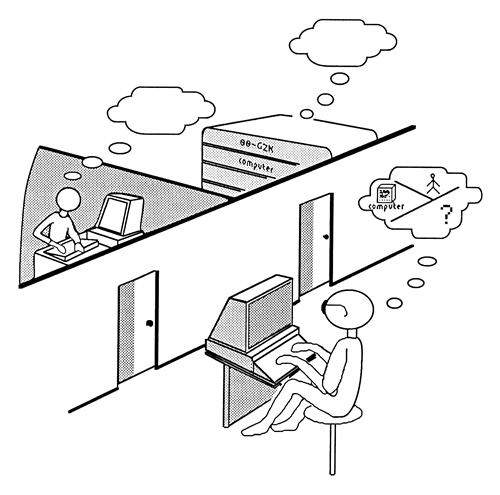
It is worth looking at a hypothetical visual version of an interrogation test, as it might have been carried out a few decades ago. Via a normal TV screen a human is shown views of different places around the world. Some are real photographs and others are computer generated images, and the aim is to see if the computer can generate images from a general verbal description and fool the human into thinking the computer images were taken by a camera. The person programming the computer knows that the task will be difficult and narrows the scope of the test - for instance by artificially confining the views of the Rocky Mountains. He does this because he knows all about the mathematics of fractals - which can be useful in generating variations in landforms - and knows that it is easier to computer produce realistic images of forests of conifers - rather than mixed deciduous woodland. Because at least some of the landscapes should include signs of human activity special code is added to generate log canons, roads wandering along valley bottoms, and even tiny images of cars on those roads.

While such computer graphic techniques, when fully developed, have proved very valuable in constructing realistic sets in the film industry the guessing game tells us nothing about how camera lenses and photographic films combine to produce the "normal" images. Similar limitations apply to Eliza-style computer programs such as Eugene, which actually say very little about haw the brain works. Perhaps 40 or 50 years ago some people honestly thought that by writing such programs would tell use something about how humans think. Since then many millions of man hours by academics and students in university departments have written chatbot descendants of the Eliza program usually driven by a competitive urge to write something better than their rivals. The comparative lack of progress (especially if the effects of the increases in raw computer power are discounted) has clearly demonstrated that the Eliza approach is a blind alley as far as understanding human intelligence is concerned.

Alan Turing Statue at Bletchley [From Geograph]
 Of course it was interesting that the Royal Society ran a competition to help remember the 60th anniversary of Alan Turing's death, but the competition has really demonstrated is that human brains (and not just media reporters) are not very good at critical thinking and will happily accept the hype of a well presented public relations story without any understanding of the real science that lies behind it. 

THis problem kis nothing new. One can criticise many of the early Artificial Intelligence researchers as being more interested following an academic career based on playing games than in understanding the real world problems that a human brain has to deal with. In an ideal world scientists should be free to criticise weaknesses in other people's research, and to accept such criticism of one's own research in good faith. However this is not an ideal world and it may be that my failure to get research grants and papers published in the 1970's was because my views on the establishment research meant that doors were being slammed in my face.

At the time much of the research was into game playing (especially chess), solving formal logical puzzles, and writing Eliza style packages which generated text which superficially resembled natural language. My research had a very different background. The trigger was a study of a massive commercial sales accounting system where the trading rules were always changing due to a range of market forces, and where there needed to be really good two-way communication between the computer and the human user. I realised that the approach could be generalized to handle a wide range of real world tasks where it would be useful to have a system that could work symbiotically with the user. In the early 1970's my ideas were still embryonic and, fooled by the hype, I initially ignored Artificial Intelligence research on the grounds that it was tackling a different kind of difficult problem. When I mentioned this to a colleague he said that once you got under the glossy cover most A. I. research was trivial compared with what I was trying to do, and he loaned my a copy of a newly published Ph.D. thesis on the subject.

Perhaps I should not have been surprised with what I found. My research involved tasks involving many and dynamically changing rules, with data which could be incomplete or poorly defined, and when there might be no immediate answer, or many. The Ph.D. thesis looked at formal logic problems which could be characterised by a fixed number of well defined rules, well ordered data, and a guaranteed single solution - in effect a trivial subset of what I was trying to do. Having spent the weekend reading the thesis I made a couple of minor tweaks to my research software and got it to solve most of the problems in the thesis. While my approach was basically a pattern recognition one, I found it was possible to morph it into a powerful language for processing patterns - and the problem solving package TANTALIZE was the result. This was used to solve 15 consecutive Tantalizer problems as they were published weekly in the New Scientist, and also many of the similar problems in the  A.I. literature. 

There was only one problem - peer review! Papers which included descriptions of my system processing logical problems (including copy listings and timings) were rejected with a bald "too theoretical - will never work". On one or two occasions I was told that I couldn't expect a paper to be published if I used used CODIL [which is a pattern-recognition language which doesn't distinguish between program and data] because all papers on A.I. had to be written in pop-2 [a conventional rule-based programming language popular in the leading A.I. departments in UK at the time]. Finally a paper aimed at a top American journal came back with a rejection slip and four reviews. One was favourable, one reviewer admitted he didn't understand what I was doing, and two were about as insulting as an anonymous critical review can be.  By this stage I was so depressed I decided to abandon all A.I. research, and switch to other application areas ofn CODIL. It was only some years later that I read the end of the coveringrejection letter. The editor (who would have known who had written the reviews) ended by urging me to continue the work because he thought there was something in it to annoy the reviewers so much!

Tuesday, 10 June 2014

Punch Drunk research into human evolution

I recently saw a lot of media hype about the idea the men have more robust jaws than women because pugilism is a natural way of sorting out disputes between our ancestors. I was wondering whether it was worth following this up when I found the blog post The human face evolved to take a punch? Spoiler: no on Evolanth and the associated discussion which highlights some of the weakness of the case.

However one must realize that even if fighting was very rare a human face should not be fatally vulnerable to an occasional punch and I posted the following comment:
The key thing to realize is that humans are not well-endowed with natural protective features - such as horns or a mule-kick. The hand has clearly evolved to be able to punch any attacker with the minimum danger of self-injury.  The shape of a clenched fist helps to minimize the possibility of damaging the fingers, with special arrangements to protect the thumb.
The evidence is looking very much as if early humans split into a number of distinct groups which could still interbreed (for example us, the Neanderthals and the Denisovans) and different lines could well have different ways of socially interacting, some possibly involving aggressive male interaction. In the circumstances one would not expect human facial bones to be particularly vulnerable to damage from a clenched fist.
While I feel the paper has overstated its case it makes sense that a human head has evolved so the owner is not incapacitated by a single blow!

Monday, 9 June 2014

Primary School Children know the answer "Which came first - the chicken or the egg?"

Children are asked to "Draw a ring around the item that needs to come first."

This example of tests in some educational books comes from "Weird Science" on the Daily Mirror website. It also included an example relating to teaching the Laws of Thermodynamics:
You can't shovel manure into the rear end of a horse and expect hay to come out of its mouth.
O.K. This is a highly memorable example if you are teaching thermodynamics to a class of 8 or 9 year old boys - but normally the subject comes a lot later in the school curriculum.

A Blooming Buzzing Confusion at Amersham on Wendnesday June 11

Robin Ince is a stand-up comedian, actor and writer. He is best known for presenting the BBC radio show The Infinite Monkey Cage with physicist Brian Cox. The programme won a Gold Award in the Best Speech Programme category at the 2011 Sony Radio Awards.

On Wednesday evening he will be talking to the Chiltern Humanists at Amessham and they say that 
his title may be a quote from William James's book The Principles of Psychology, published in 1890. James described the mental experience of the newborn infant as a "blooming, buzzing, confusion", meaning that at first, infants do not experience the world like adults (or even children) do, populated with distinguishable objects and surfaces that possess features such as size, color, shape, and meaning. In other words, they don't see the couch, a coffee table, a rug, or the dog - they don't even see you as a 'thing' with any meaning.

Because of my interest in the evolution of the brain I am looking forward to hearing Robin with enjoyment - some serious thoughts on the subject with a humorous presentation.

Sunday, 1 June 2014

I'm supposed to be counting calories

thinkstockphotos
Recently my doctor suggested that, for my own good, I should cut back on portion sizes and select a healthier selection of foods, eaten in moderation. Things have started in the right direction - but every now and then I get an urge to "enjoy" a good hearty meal. When the urge came today I decided to imagine I had been to an "eat as much as like" restaurant - and write a limerick about it.
Give me wine, put it down on the slate,
Pile the meat very high on the plate,
And a fish course, and sweet,
Give me all I can eat,
And to hell with my own body weight.
And its worked - the very thought of it has made me feel full!

Friday, 30 May 2014

Google and the problem of personal information

Before I retired I was particularly interested in the problems of data protection and on-line communications long before the world wide web came into existence. In the 1980s I wrote a paper for a scientific conference about the problems of reconciling the Data Protection Act with the online task of organizing an international conference involving committee members scattered around the world - and I was delighted when it was republished by a legal journal.

The recent Court ruling that Google (and other search engines) should suppress links to "personal information" looks totally unworkable because in free text documents, such as old newspaper reports, drawing a clear distinction as to which links to suppress and which links, to the same news story, not to suppress is clearly unworkable. On my other blog/web site I am frequently researching local and family history in old newspapers and on Google (admittedly too old to be affected by this ruling) and know a lot of trips for digging out hard to find information. With this in mind I posted the following on the British Computer Societry Web site as a comment on the news about the proposed "censorship".
As someone who retired from IT many years ago and now is active doing historical research I find the idea of manipulating historical records, and the tools for accessing them very worrying and I can't seen how the approach the court has proposed could possibly work. 
I could think of hundreds of different scenarios - but I will mention just one. A footballer does not want anyone to know he might have been involved in match fixing and the record shows that he played in a game in which he played. There are a number of levels - the protesting player was (1) convicted of fixing (2) appeared in court but found not guilty (3) was named in the evidence given in court but not charged (4) named as a player in a game known to be fixed (5) not named in the report of fixing, but the game is identified as being fixed - and other reports name him as a member of the team. 
A search engine like Google will provide many pathways to find details to the match, the fact that it was fixed, and the players. Let us assume that  a request was made to remove all links which might indentify a individual because the facts about him were "time expired" personal information. As a historian (and I am sure investigative journalists are at least as good as me) I know lots of tricks for search free text documents. But how could Google realistically hide this information without preventing access to other information relating to the game and other players. For instance should all the members of the team be indexed apart from the complaining member? Should Google images suppress a picture of the whole team "involved in the fixing scandal" or should they have to block out the clearly recognisable face of the complainant. 
If I was particularly researching the fixing of football matches and I came across a case where some of the player's name were not findable using Google I would immediately be alerted to the fact that the unindexed players had something to hide ... which could encourage me to look specifically for what the complainant was trying to hide. 
Information held as free text, such as old newspaper reports, beings lots of problems - for instance Google does not distinguish whether "Tottenham" is the name of a person, a football team, or a place - and most texts will refer to many different people, events, etc., (some of which must continue to be indexed) and not just the subset of news complained of. 

Wednesday, 21 May 2014

Two Limericks for the price of One!

Bow
Bow
I have somewhat neglected this blog recently - in part because of some problems with my asthma - but I still have had fun writing limericks for an online competition.  My latest entry (slightly modified here to remove an explicit reference to the competition organizer) is given below. 

It  takes the form of two different limericks which - in writing - are identical apart from the last two syllables. In order to be able to read it you need to look at the end of the final line to get the right pronunciation for the ends of lines 1 through 4, noting that the limerick only makes sense if lines 3 and 4 do not rhyme with lines 1, 2 and 5.

The example's first line ends in "bow"
And the poet had rhymed it with "row"
'Cause if he rhymed "row"
Or misused the word "sow"
The judge would reject it and how.
The example's first line ends in "bow"
And the poet had rhymed it with "row"
'Cause if he rhymed "row"
Or misused the word "sow"
The judge would reject it also.