Wednesday, 9 July 2014

Wednesday Science Limerick: Why MSG is added to food

Your food can be bitter or sweet
You sense sourness or salt when you eat
While umami's the flavour
The taste that you savour
When something is really a treat.


Many processed foods contain monosodium glutamate (MSG) and on the packets it is sometimes described as a flavour enhancer.As someone who trained as a chemist I knew that it was the sodium salt of glutamic acid (2-Aminopentanedioic acid if you really want to know) and is one of the amino acids that make up the proteins in our body. However I had no idea why it was added, or how it worked, so I decided to have a dig around on the web - and found an exciting story about taste which I had never learnt at school.

I was brought up to think that our taste buds could detect four different tastes - sweet, sour, bitter and salt, and this was complemented by the sense of smell. However about 100 years ago a Japanese researcher, Dr. Kikunae Ikeda, was trying to find out why a stock made from the seaweed kelp improved the taste of many other foods. He found that the stock contained glutamate and that it provided a distinct taste. This 5th taste is now known as umami, which is a Japanese word (うま味meaning "pleasant savoury taste" and there are special receptors in the tongue that react to the presence of glutamate in the food.

It turns out that there are four kinds of taste receptors, each found in a different parts of the tongue. If you want to dig deep into the technical aspects see the Wikipedia pages on Taste Buds and Taste Receptors.

Filling the Black Hole in Brain Research

Three years ago I posted Brain Storms - 2 - The Black Hole In Brain Research suggesting why there were problems in bridging the gap between the brain's neural network and human intelligence. Earlier this year both the E.U. and the U.S.A. announced multibillion pound projects to try and bulldoze a solution. P.Z. Myers has now posted a blog What are you going to simulate? on Pharyngula and I have posted the following comment, which may be lost among nearly 100 other comments on his site.
:::::::::::
The research seems to be working on the assumption that if we knew all the connections we would automatically understand how the brain works and what makes us different to animals. I would suggest that the best way to understand how the brain works may well be to start at the animal end and consider the possible evolutionary pathways. For this reason I agree with P.Z. when he says

 What the hell? We aren’t even close to building such a thing for a fruit fly brain, and you want to do that for an even more massive and poorly mapped structure? Madness!” It turns out that I’m not the only one thinking this way: European scientists are exasperated with the project.

Tuesday, 8 July 2014

Chimpanzee Language - Is it a model for a primative language in early hominids

There has been a lot of online interest in the paper The Meanings of Chimpanzee Gestures by Catherine Hobaiter & Richard W. Bryne, which has just been published in Current Biology. The abstract ends: Here we present the first systematic study of meaning in chimpanzee gestural communication. Individual gestures have specific meanings, independently of signaler identity, and we provide a partial “lexicon”; flexibility is predominantly in the use of multiple gestures for a specific meaning. We distinguish a range of meanings, from simple requests associated with just a few gestures to broader social negotiation associated with a wider range of gesture types. Access to a range of alternatives may increase communicative subtlety during important social negotiations.

The researchers claim that they have decoded 66 different gestures whose meaning is the same whichever ape was making a gesture. For instance if a mother shows the sole of her foot to a baby it means "climb on me", while touching an arm is a request asking to be scratched. Interestingly chewing leaves is an invitation for sexual attention. Apparently several gestures can be strung together to represent more complex exchanges.

For the time being I feel rather frustrated, as the full paper is behind a paywall, and I would really like to assess the strength of the research for myself - rather than being dependent on the first wave of press release news reports. However there has been plenty of earlier work which establishes that a social animals such as the chimpanzee must be communicating, and I am sure that if there are any weaknesses in the current paper comments will soon turn up on various blogs elsewhere. 
Chimpanzee communication signals

However if wild chimpanzees in Uganda have a language of over 50 gestures it is interesting to  think how many gestures (or simple vocal sounds) would an early hunter-gather hominid need to be able to organise hunting by ambush or describing the location of a food source, in addition to normal social interactions. I would have thought a hundred different signals relating to actions and the ability to name a hundred objects would prove a powerful survival tool - and is not much more than appears to have been demonstrated in chimpanzees. Such a language could be far more primitive than the proto-language that is believe to have preceded all modern languages. 

Of course my estimate is only a guess. Has anyone done any research on the size of vocabulary needed to plan and execute a complex hunt?

Monday, 7 July 2014

Should Alice be expelled from Wonderland

Charles Dodgson (who wrote under the name Lewis Caroll) took up photography in 1856 and many of the pictures he took were of young girls, including Alice Liddell, who was the Alice in the story.  Some of his photographs showed pre-pubescent girls naked.

In the light of the media frenzy which has recently surrounded the case of Rolph Harris perhaps we should also be protecting our children from reading about Alice in case they get corrupted.

Of course this is nonsense. There is no evidence that Charles Dodgson was a paedophile.  Most of the pictures of the young girls are known to have been taken with their mothers being present, and sometime the session also included photographs of the mother. This was all at a time when pictures showing the innocence of childhood were fashionable.

But even if Charles Dodgson had ulterior motives this should not stop anyone, of any age, enjoying Alice in Wonderland, or Alice through the Looking Glass.  Poetry such as The Hunting of the Snark would still appeal and his work on mathematics would not be diminished.

So back to Rolf Harris. He was a human being with failings - which is nothing unusual as no human is perfect - but he was also an extremely talented entertainer whose on-stage art must have inspired millions. He also supported many charities and he deserves to be remembered for the good he has done.

Sunday, 6 July 2014

The Infinite Monkey Cage restarts Monday

Brian Cox and Robin Ince start a new series on Radio 4 on Monday at 4.30 pm, when they will be discussing our relationship with numbers.

Saturday, 5 July 2014

Down an Icy Hole - brings back memories of my youth

In my youth I used to explore cave and became very interested in how they were formed. Pictures like this striking one from the New Scientist reminded me of the time I spent many hours doing research in muddy holes in Devon. They may have been a lot warmer than this one, but they were much smaller. 

(Image: Ingólfur Bjargmundsson)

Wednesday, 2 July 2014

Wednesday Science Limerick - Our Ancestral DNA


Lifelike figure of a Neanderthal Man in the Neanderthal Museum in Germany
It would seem a Neanderthal man
Met a sweet little Denisovan
And their child’s DNA
Is still with us today
As a part of our genetic plan
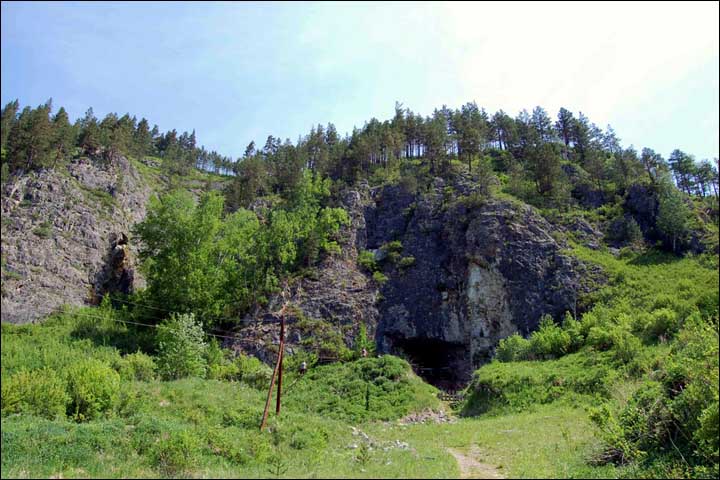
Denisova cave in Altai Mountains, SIberia, viewed from the road
Remains of Denisovans, Neanderthal and modern humans have been found in the Denisova cave, and genetic testing has proved that the three sub-species of Homo interbred - with, for example - the Australian aborigines having more Denisovan genes than  do Europeans. It could well be that human evolution is typified by the formation of separate groups, probably with different cultures and way of gathering food. The most successful groups prospered. Climate change, driven by the Ices Ages, would cause groups to migrate and any cross-breeding would allow the more useful genetic changes in the different groups to be shared.

New research results are appearing all the time and only a week ago there was a detailed press report Skulls with mix of Neandertal and primitive traits illuminate human evolution from the American Association for Science about 400,000 year old skeletons found in a Spanish cave. At the same time a paper in Science, The genetics of Mexico recapitulates Native American substructure and affects biomedical traits, suggests that some indigenous Mexican groups are as genetically different from one another as Europeans are from East Asians. This paper suggests that some groups have been isolated for hundreds of thousands of years. [However I am waiting to see other comments on this claim as it is thought that humans only reached America about 15,000 years ago!]

Tuesday, 1 July 2014

Is Language the key to understanding human intelligence?

In my previous post I referred to a paper with a title that ended with the words “Modern Human SuperiorityComplex” and these words were at the back of my mind in reading the book “Louder than Words” by Benjamin Bergan. I am currently drafting a paper on my evolutionary approach to a symbolic language to explain how the brain processes information and I decided to read this book to help me clarify where my ideas fit with recent cognitive science research and where there are discordances which I need to address in my paper.