 |
| from The Times, 31st May |

Friday, 3 June 2016
Trapped by the Referendum It will be a disaster whatever the result
There is no escape. The referendum will happen and the result, whatever it is, will be a disaster, because it is addressing the wrong issue in a way that can only make the current situation more unstable.


Sunday, 29 May 2016
The Australian Government is burying its head in the sands of the Great Barrier Reef
In 1990 I flew to Australia to work on a computer system to provide information relating to the possibility of climate change -see To Australia in a Box. Shortly after I arrived the project was cancelled, because it was clearly not considered a sufficiently important project to spend government money on it.

Since then climate deniers in the Australian government have come and gone - and the temperature has continued to rise - with more and more highest temperature records being broken. It is clear that warmer seas made more acid by the increasing levels of dissolved carbon dioxide could have a serious effect on natural features such as the Great Barrier Reef.
A news item today reveals that the Australian section of the UN World Heritage site report on the effects of climate change has been axed. Apparently the Australian Department of the Environment still believes that burying one's head in the sand and hoping the problem will go away is the answer to the realities of climate warming. At least their attitude is clear - the whole world now knows that the Great Barrier Reef is not in safe hands.
We should not underestimate the Neanderthal Mind
 |
| Neanderthal "rock circles" |
Looking Back over 50 years computing
 |
| Fastrand II |
I entered the computer industry just over 50 years ago, and a purchase I have just made really brings home the scale of change over the years.
In 1966 my employer, Shell Mex and BP, was planning to move from a batch processing Leo 3 system involving the files of some 250,000 customers to a new computer which had direct access storage. In 1967 placed an order for a Univac Computer with FastRand drum drives. Each drive could store 100 megabytes of data and cost about £100,000. It came in a large cabinet and weighed about 2,200 kilo.
 This weekend I decided to reorganise all my computer files as part of a move from Windows XP on a rather tired desktop to a laptop under Windows 10. These files include historical archives going back some 25 years, and urgently need restructuring. I purchased a drive big enough to hold all my personal files from several generations of personal computers and separate hard drives. The drive cost about 30,000 times less than a Fastrand (adjusted for rise in cost of living), weights about 100,000 times less, and can contain about 20,000 times more data!
Monday, 11 April 2016
Brain - The Last Frontier
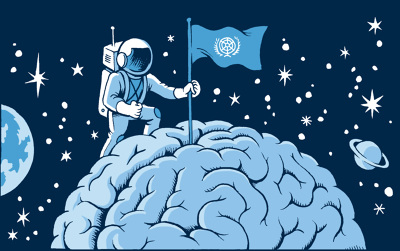 |
| Brain - The Last Frontier by Matteo Farinella |
However there is no point in giving me a pen or paintbrush because any attempt to produce an attractive picture using such tools would be a complete waste of time - and I admire those who can combine artistry with science. I was therefore delighted to learn of Matteo Farinella's blog.
Matteo is a scientist who did a Ph.D. in computational neuroscientist - and then decided to become a freelance cartoonist. He has just become a Presidential Scholar in Society and Neuroscience at Columbia University with the goal of creating "a new paradigm for interdisciplinary university-sponsored research to advance understanding of mind, brain, and behavior, and the social foundations and consequences of new neuroscientific findings."
I wish Matteo well in his endeavours and will certainly be following his blog with interest. My feelings are that much existing research in computational studies of the brain are so deeply involved in"fine science" and "sophisticated mathematics" that the human side is forgotten. Matteo's cartoons could bring in a welcome breath of fresh air.
Sunday, 10 April 2016
The Leo Computer Society Reunion
 |
| The Leo Computer Society committee line up for a photograph. |
Saturday, 9 April 2016
The Link between Codil and the Evolution of Human Intelligence
The following notes have been prepared for the Leo Computer Society Reunion on April 10th. It is a brief summary describing the link between the original observations made of how salesmen understood complex sales contracts at Shell Mex and BP and later research in CODIL. It also outlines the recent reassessment which relates the earlier work to neural nets and the relevant to research into human intelligence. If you want to know more do not hesitate to contact me.
The
Surprising Connection between the Leo III and Research into the
Evolution of Human Intelligence
by
Chris Reynolds
10th
April, 2016
In
1967 I was asked to look in detail at the Shell Mex & BP sales
accounting programs which ran on their Leo 3 computers at Hemel
Hempstead. The aim was to see how they might be moved to the next
generation of computers – which would have computer terminals. The
result was a proposal for a computer with a user-friendly symbolic
assembly language called CODIL (COntext Dependent Information
Language). Nearly 60 years later it is possible to link my original
observations on how salesmen though about contracts with a model of
how human intelligence may have evolved. This note briefly explains
the link and suggests that some way should be found to
re-vitalize the research.
Friday, 8 April 2016

Subscribe to:
Posts (Atom)