 |
| Ashridge is a large National Trust Estate a few miles from Tring, Hertfordshire Click for a larger image |

Sunday, 28 October 2012
Rural Relaxation - An Autumn Afternoon at Ashridge


Tuesday, 16 October 2012
What links Jimmy Savile, the Defamation Bill, and my research
 |
| What does the cigar look like? Someone has obviously just "Fixed It" for Jimmy Savile |
Almost everyone in the UK knew about Jimmy Savile - he was a disc jockey who became a TV star with mass audience programmes such as Top of the Pops and Jim'll Fix It, which arranged to make the wishes of children and some adults come true. He did a significant amount of charity work and is estimated to have raised £40 million, particularly for Stoke Mandeville Hospital. He did voluntary work in Broadmoor mental institution for 40 years, where he had special access privileges, and as a porter at Leeds General Infirmary. There were links with the Haut de la Garenne childrens home in Jersey, and charities for the disabled. Now that he has died it is becoming apparent the Jimmy was a predatory sex offender who was very good at fixing it for Jimmy - obtaining access to a wide range of vulnerable people and abusing them. At the time of writing this the police are following 340 possible lines of inquiry and this has so far led to the identification of 40 under-aged or vulnerable victims - and it is likely the numbers will increase.
 |
| Simon Singh |
While new revelations were in the news every day I got an email from Simon Singh with a link to the House of Lord debate on the Defamation Bill - which is concerned with the threat of the libel laws to science, consumers and citizen. Simon is a scientist writer who wrote an article in The Guardian critical of certain medical practices and was sued by the British Chiropractic Association. He is now threatened with another action for making scientifically valid statements which criticize a fringe medical magazine. The problem relates to the weaknesses in the UK libel law which makes it easy for powerful organisations and individuals almost anywhere in the world to threaten cripplingly expensive legal action to crush genuine criticism into submission. Simon's email reportst that 60 international non-government organisations recently pointed out the severe limitations of the proposed bill:
English libel law has been shown to have a chilling effect on free speech around the world. We believe that the Defamation Bill will address this in part by tackling libel tourism, where foreign claimants have brought libel actions to the English courts against defendants who are neither British nor resident in this country. However, the Bill as it stands would not have prevented any of the libel cases that we have seen over the last few years against journalists, scientists, doctors and activists who have spoken out on issues that are in the public interest.
What do these two cases share in common with what happened to my own research project? The answer is the ability of the bully with power to take advantage of the vulnerable, while others look on and don't want to get involved.
As one of the patients assaulted by Jimmy Savile at Broadmoor has said - "Whats the point in complaining, I was mentally ill so if I complained about Jimmy, he was viewed in such high esteem that everyone would assume I was lying." Years ago a 15 year old girl who had been a dancer on Top of the Pops committed suicide and left a diary describing how she had been "used" by celebrities (including Jimmy Savile) in the dressing rooms - and her account was dismissed as teenage imagination without being followed up. Within the BBC, the hospitals, and other institutions most people with little more than suspicions considered it diplomatic not to get involved because of Jimmy's status, and those who tried to whistle-blow seem to have been met with disbelief - "It couldn't be our Jimmy - and we don't want to upset him because he does so much good work".
What Simon Singh's experience has shown is that powerful organisations involved in fringe medical practices of dubious efficacy can use the current British legal system to try and silence informed whistle-blowers by threatening to bring the tremendously expensive legal cases, which would bankrupt the individuals concerned.
 |
| Me |
And what about my case? I was engaged in highly controversial research which was exploring the limitations of stored program computers - and was trying to build a "White box system" which could always tell the user what it was doing in the user's terms - as opposed to the "black box system". Extensive details of the CODIL approach and its history are given elsewhere on this blog and will not be related here. The important thing is that in 1986 I produced a prototype software version (in part inspired by a Jim'll Fix It programme) which ran on the BBC computer for use in schools and got rave reviews from a wide range of publications. In 1987 a paper describing the research was accepted by the top professional journal for computer research and the future of the project should have been rosy. If successful the research could have made a very significant contribution to the personal computer industry and computres would be much more human friendly. (In fact it now looks as if the research could be relevant to brain research - but that is another story).
However the project (and my career) ended abruptly in 1988.
Why? Basically a bully with a lot of charisma and the ear of the Vice Chancellor became head of the university department where I was working. I was very vulnerable, having been bullied unmercifully as a schoolboy, and because my daughter Lucy had recently committed suicide as a result of significant suffering imposed by a bullying Criminal Justice system. A campaign of vicious bullying left me in a very week situation and I agreed to take early retirement - and having retired did not have the energy to continue the research on my own. Colleagues were either blinded by the charisma of the new head, or felt it safer to take a low profile. Friends in other departments did not want to interfere - until a few years later the bully was promoted to head of school and there were protests from those who had quietly watched from the sidelines, saying nothing, who suddenly found he was now above them. A union inquiry showed that a lot of people had been bullied by him and to avoid a scandal he was given a year to find a new job (and victims?) elsewhere.
 The point of this is that there are plenty of bullies in all walks of life who target the vulnerable - as victims or as gullible customers. Most other people sit back and say "Its none of my business" and the victims suffer. The current culture is that in practice whistle-blowers who stand up for the disadvantages against the establishment are usually ignored or turned into victims - despite all the "politically correct" guidelines on the subject. The current libel laws, and the proposed new bill, seem designed to ensure that those with power can use the courts to brow-beat the pesky whistle-blowers into submission.
Sunday, 2 September 2012
Will the Arctic be Ice-free in my lifetime?
First became interested in global warming over twenty years ago (see Global Warming - to Australia in a Box) and I read the various reports in the scientific press with increasing gloom as we are trapped on a planet where the climate is changing due to our actions - and there is not a hope in hell of politician getting their heads together round the world to take sufficient action to do anything to halt the process. For instance as things get hotter and dryer in the U.S.A. I can see the demands to extract even more oil will go out in order to keep the air conditioning running.
This morning there was nothing further from my mind as I am trying to down-sized my library by selling off some books on ebay - until I picked up a copy of Tales of the Northern Seas, published in 1870 and came across this picture:
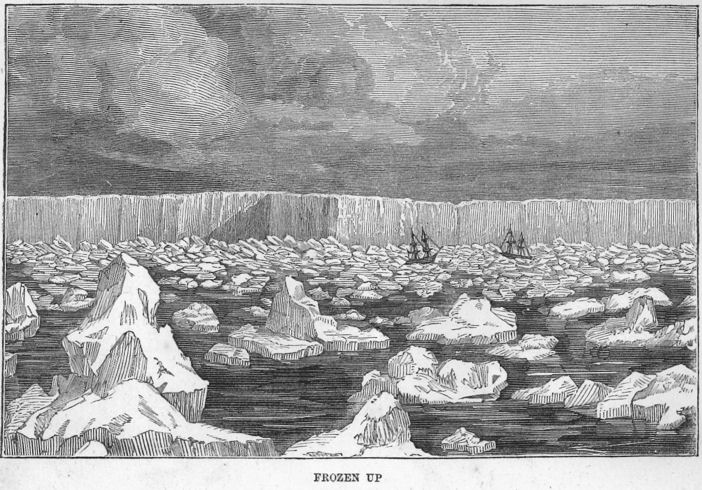
I shivered. It could only be a few years away that the North West passage will be ice free every summer. And while I will be 75 next year there seem to be a real possibility that the first summer when there is no ice cover over, or even near, the North Pole, will come before I die.
Tuesday, 21 August 2012
A Skeptical view of science.
Ilana Yurkiewicz has just written a piece The downside of politicians talking about science which includes the following passage:
That mentality just doesn’t work in science. Those who are new to a subject are intimidated from asking questions and afraid to disagree. Rather than reason through ideas themselves, they are pressured into accepting conclusions presented as settled and thereby indisputable. But the thing is, nearly everything in science is disputable. The nature of discovery means trying to find the absolute truth – and exposing inconsistencies, thinking through how to reconcile them, and critically analyzing data are all ways to get there. We can’t get very far when curiosity and open inquiry – the hallmarks of good science – are stifled. We are touting the bottom line while discouraging the very steps of the scientific method that get us there.
What we have to realize is that science and politics have fundamentally different goals, and it’s damaging to conflate them. In politics, the aim is to convince others that you are right. Scientists, ideally, should be seeking objective truths. To do so, they need to be receptive to dissent and open to the possibility of being wrong. Science thrives when diverse ways of thinking are welcome.
Wednesday, 15 August 2012

Monday, 6 August 2012
My Batty Past is in the Can
 |
| College Lake Reserve (more photographs) |
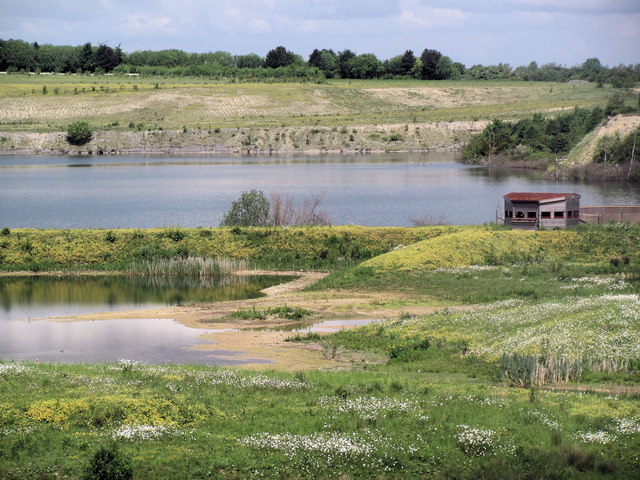
At the end of July I went on an evening safari around College Lake (a nature reserve near Tring, Hertfordshire) the idea being to see bats (which have been hit by the unseasonable weather) and glowworms (which were reasonably plentiful). Then today I went again - but just for a day time exercise walk and a sandwich lunch.
 |
| Lesser Horseshoe Bat in Devon Cave (Devon Wildlife Trust) |
As I was about to leave one of the volunteers called over to ask how I had enjoyed the safari. I mentioned how interested I was in the electronic bat detectors - which had not been invented when I first worked with bats. This started some reminiscences about some of my early involvement in research started nearly 60 years ago in Devon and my involvement in the foundation of the William Pengelly Cave Studies Trust. I also mentioned how I got involved in bat ringing with the pioneering work on Horseshoe bats in Devon caves with John and Winifred Hooper. John was also interesting in filming and I described the first attempts to film bats in Beer Quarry Cave, possibly in about 1956. These disused mines were chosen because they were easy to access - with a level floor - and the lesser horseshoe bats, which we planned to film, showed up well on the light coloured walls. My brother and I were filmed looking for the bats - as was the Hooper's young daughter - who was just starting to talk - and so one of her first words was "bat". A year or so later the film was shown by the BBC - perhaps on Blue Peter.
At this point the person I was talking to said that recently he had seen seen the film - as part of a number of early bat films shown to a meeting of the North Bucks Bat Group. The person showing it had made some comments about the youngest member of the party, pointing out that then no-one was concerned about Health and Safety legislation!
So some of my early batty research is still "in the can."
Monday, 30 July 2012
The Black Hole in “The Believing Brain”
Some
comments of Michael Shermer's book “The
Believing Brain”
How you react to this book, which has just been issued as a paper back, will depend on your own individual belief systems. In setting out to read it I felt it appropriate to identify places where the book reinforced my own beliefs and – more importantly – where there is a conflict – and why. As a result what follows is a personal commentary rather than a formal review. In particular it ends with a discussion on theories of how the believing brain works. It also looks at some of the reason why your believing brain might not accept an unconventional evolutionary model which suggests that the human brain is little more than an enlarged animal brain which is only more powerful because it has more neurons, has more synapses, a modified developmental framework and similar straightforward homologous changes.
Wednesday, 25 July 2012
This House Believes that God is a Delusion
 |
| Across Hemel event site, Gadebridge Park, Hemel Hempstead |

ACross
Hemel (an association of Churches in the Hemel Hempstead
area) has organised a summer family event in
Gadebridge Park. This included an evening debate, held yesterday,
with the challenging title “This House Believes that God is a
Delusion”, to be proposed by Richard Norman, a Vice President of
the British Humanist
Association, with the case against being put by Justin
Thacker, chair of Across Hemel.
Subscribe to:
Posts (Atom)