


I have just returned from the Leo Computer Society's Diamond Jubilee Reunion which was held in the Hall of the Middle Temple and there was a good turnout with about 150 people who had worked with the pioneering Leo Computers, together with some friends. In my case I had programmed a Leo III computer at Shell Mex and BP, Hemel Hempstead between 1965 and 1967, before moving on to work with English Electric Leo Marconi between 1967 and 1970 (when it had become ICL).
As always, at such events, there were short presentation from some of the pioneers and there was a chance to exchange stories with old collegues, although as time goes by there are the inevitable news of someone who has passed on since the last reunion. At the previous reunion I had not found anyone who had worked at Hemel Hempstead at the same time as I was there - but this time I met two - and also several regulars from the time I worked at Computer House, Euston.
Of course, when I was working in the 1960s I only saw a small part of the action and the reunion gave me a change to talk to people who had worked on the design of the hardware through to programmers and systems analysts who had worked on different applications for different organisations - a stimulating experience.
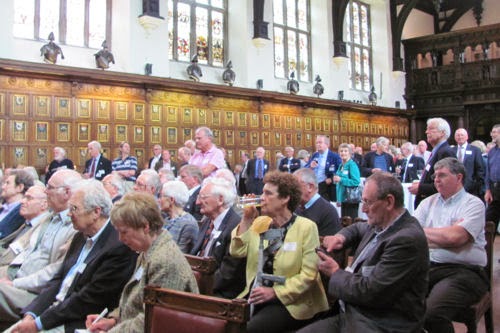
There was some original hardware on display, and photographs of the Leo computers - and a good display on manuals. On the historical front I was interested to here that the old Intercode assembler program is now up and running so that anyone who has a program from that date can now run it. There was also an appeal to see if anyone had a listing of the CLEO compiler and it would then be possible to compile historic CLEO programs.
CLEO (Clear language for Expressing Orders) was an interesting high level language which could be considered as a hybrid between CODIL and Algol - and it was the first language I ever used. I was one of the first programmers to use CLEO as their first language in 1965 and quickly became an expert in it. However for some application I later learnt to use Intercode. At the time John Ruddle was the chief programmer at SMBP and when the company was planning to move from batch processing using magnetic tape storage to a system with online capabilities he wanted me to work on the operating system requirements of the computer that would replace the Leo IIIs. My interest in computers was at the human end - and I objected the the proposed move - which is how I came to work on the options from transferring the complex sales contract application onto the new machine. This decision had a big effect on my life as my investigation into the sales system led directly to my later research into CODIL.
[For a detailed account of my early programming experiences see ]


